



Note: This continuing series reposts some of the most memorable columns of Suzy’s Fancy, which ran from 2009-2020. This piece originally ran in January 2015.
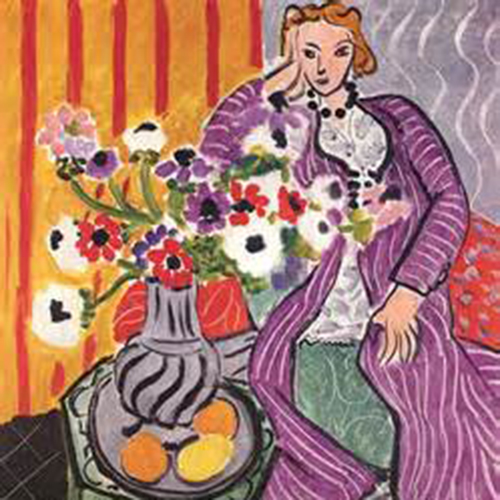
Oil on Canvas, Baltimore Museum of Art
I’ve always loved the paintings of Henri Matisse (1869-1954), and I think one of the reasons is because they usually feature textiles of some sort.
Matisse loved fabrics! To me, there is something quilter-like about the way Matisse combined patterns and colors in unexpected and exciting ways.
Last year, I had the great pleasure of getting to see two wonderful exhibits of Matisse’s work: 1) Life in Color at the San Antonio (Texas) Museum of Art, which featured works drawn from the Cone Collection at the Baltimore Museum of Art. (In 1906, sisters Claribel and Etta Cone of Baltimore met Matisse in Paris and, over the course of 40 years, bought more than 500 pieces from him.); and 2) “TisserMatisse,” an exhibition at the Musée d’Art Moderne in Troyes, France, the first of its kind to focus on the artist’s textile works, specifically large tapestries that he had created from some of his paper collages and paintings.
It’s not surprising that textiles played such a crucial role in Matisse’s work. The descendent of generations of weavers, Matisse grew up in the far northern part of France, not far from the Belgium border, in an industrial town called Bohain.
Since medieval times, Bohain had been known for its textiles, and the town’s weavers were celebrated for their bold experimentation with bright colors and patterns.
According to Hilary Spurling, a Matisse biographer and author of the catalog for a 2005 London Royal Academy of Art exhibition entitled Matisse: The Fabric of Dreams—His Art and His Textiles, “[Bohain] was a place where everything was pretty dull, except the fabrics, where the streams from the dye works would literally run pink or scarlet—that’s what trained [Matisse’s] eye in color…. There were no galleries, museums or art collections on display, virtually no public statuary, not even a mural in any of these smoky [industrial] towns…the only available outlet for a nascent visual imagination came from the sumptuous, shining, multicolored silks produced in weavers’ cottages and workshops all over Bohain.”
From a young age and throughout his long life, Matisse collected textiles of all sorts, including bright cotton and silk yardage, upholstery fabrics, tablecloths, curtains, carpets, Parisian haute couture gowns, Turkish robes, Romanian peasant blouses, patterned African raffia cloths, tapestry fragments, Arab embroideries, sashes, and cloth and garments purchased from markets in Algeria, Morocco and Tahiti.
He called his textile collection his “working library,” and it went with him whenever he moved. Hillary Spurling states, “Fabrics made him feel at home. Like virtually all his northern compatriots, he had an inborn appreciation of their texture and design. He understood the properties of weight and hang, he knew how to use pins and paper patterns, and he was supremely confident with scissors.”
A look at practically any of Matisse’s paintings will reveal textiles of some sort. “Used traditionally at first, as mere background elements in his compositions, textiles soon became the springboard for his radical experiments with perspective and an art based on decorative patterning and pure harmonies of color and line.” (Metropolitan Museum of Art)
Describing Matisse’s work, the British art critic John Berger said, “He clashed his colors together like cymbals, and the effect was like a lullaby.” Haven’t we all seen quilts that produce the same effect?